
Wind Damage: Lifted and Missing Shingles in Decatur
Decatur’s Wind Environment: Why the Tennessee Valley Concentrates Storm Energy
Morgan County’s position in the Tennessee Valley creates a wind exposure profile that is meaningfully different from both the Gulf Coast markets to the south and the inland plains markets to the north. The valley terrain — the ridgeline running from Joe Wheeler State Park east through the hills above the Tennessee River, the broad flat plain of the river corridor, and the elevated terrain on the south side of the valley — channels and concentrates wind energy from severe thunderstorms that track across North Alabama on a regular basis during spring and fall active seasons. A thunderstorm that produces 55 mph gusts at the surface in open flat terrain may produce 70 to 80 mph gusts as the same system is channeled through the valley corridor — well above the adhesion threshold of standard shingles at any stage of their service life.
❓ FAQ: What does wind damage look like?
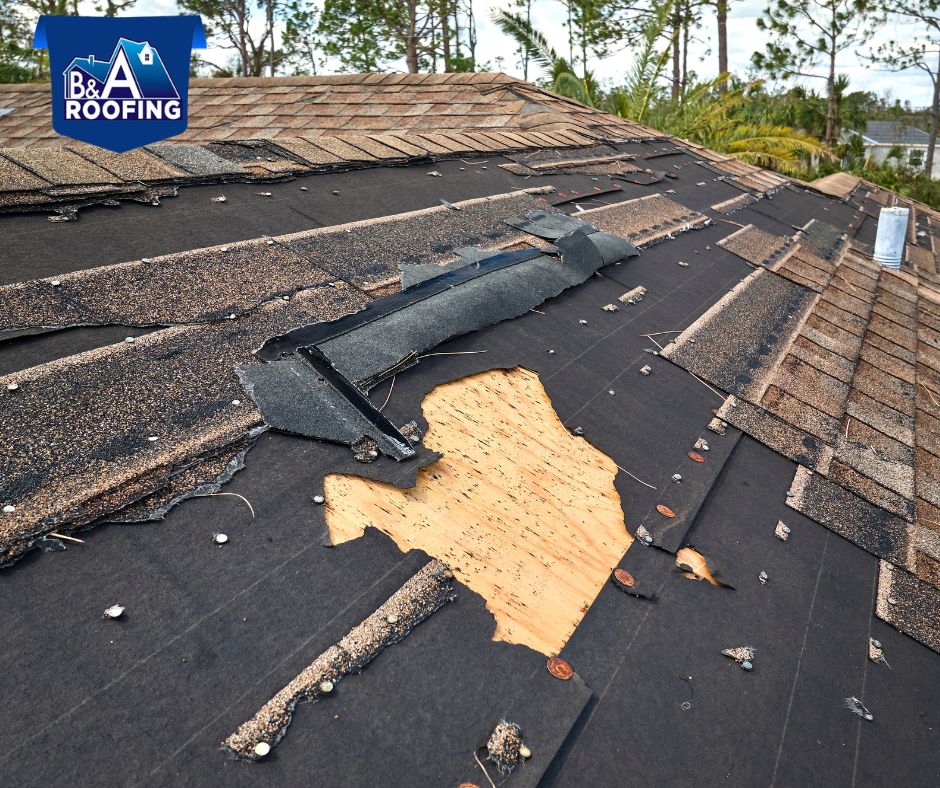
Wind damage roof repair Decatur calls come in after events that produced one of four visible patterns, each with a different severity implication. The most obvious is complete shingle displacement — sections of the shingle field where the tab has been completely removed, leaving the dark synthetic underlayment or the lighter felt paper visible from the ground. These sections are an active water infiltration risk at the next rain event, regardless of how intact the underlayment looks. The underlayment is a secondary protection layer; it is not designed for sustained weather exposure.
The second pattern is tab lift without displacement — shingles that have been partially raised by wind and either held in the lifted position or settled back down after the wind passed. Lifted shingles that settle back may look intact from the ground, but the sealing strip that was torn from the shingle below during the lift event is no longer bonding correctly, creating a persistent wind-catch vulnerability at every storm that follows. The third pattern is ridge cap damage — the special shingles that cover the ridge line are the most exposed element on any roof and the first to fail in a significant wind event. Ridge cap displacement or loss leaves the ridge board and the intersecting shingle courses unprotected at the most wind-vulnerable point. The fourth pattern is shingle cracking along the nail line — a result of rapid pressure cycling that stresses the fiberglass mat beneath the asphalt. This damage is often invisible from the ground and is one of the primary reasons a professional post-storm inspection from the roof surface itself is more valuable than a ground-level assessment. According to NOAA National Weather Service wind damage product guidance, sustained winds above 58 mph and gusts above 65 mph are the thresholds at which structural building damage and roof component failures become widespread events — wind speeds that North Alabama’s Tennessee Valley storm corridor reaches multiple times in an active season.
Eight Signs of Wind Damage on a Decatur Roof
🟥 Missing Shingles — Exposed Underlayment
The clearest wind damage indicator. Any section of dark underlayment or lighter felt paper visible from the ground means shingles have been completely displaced. This is an active waterproofing failure that needs same-day or next-day emergency tarping if rain is forecasted.
🟧 Lifted Tab Edges
Shingle tabs showing a shadow gap underneath where the leading edge has been raised but not displaced. These tabs are still in place but the sealing strip bond has been broken and the shingle will lift again — progressively lower wind threshold — at every subsequent event.
🟨 Ridge Cap Displacement
Ridge cap shingles that have shifted, crept, or been partially displaced along the ridge line. Ridge cap failure is visible from the ground as an irregular or wavy ridge line where the line should be straight, or as gaps between sections of cap shingles.
⚪ Granule Surge in Gutters
Dense granule deposits in gutters and at downspout terminations after a wind-hail event confirm surface damage that may not be visible as missing shingles. Significant granule loss accelerates UV degradation and shortens the remaining functional life of the affected shingle sections.
🟦 Hail Dents on Soft Metals
Circular dents on gutters, AC fins, or step flashings confirm the hail component of a combined hail-wind event. Soft metal dent size correlates with hail size — one-inch or larger dents indicate hail above the Class 3 threshold at which shingle surface damage becomes reportable.
🟪 Shingle Debris on the Ground
Tab fragments, whole shingles, or ridge cap pieces in the yard or on adjacent structures confirm displacement. Collect any displaced shingles before cleaning up — they serve as evidence of the event for the insurance claim.
🟫 Attic Daylight or Drips
After a wind event, a quick attic flashlight check often reveals daylight through gaps where shingles or ridge sections have been displaced. Active drips during the next rain event after displacement are the clearest signal of compromised weather resistance.
⚡ Separated or Cracked Flashing
High-sustained winds apply dynamic pressure cycling to step flashings, chimney counter flashings, and pipe boot collars that can separate or crack them without producing visible exterior evidence from the ground. Post-storm flashing inspection from the roof surface is the only reliable way to assess this damage category.
❓ FAQ: Can wind damage be repaired?
In many cases, yes — and a correctly executed repair that addresses only the truly damaged zone is the right financial and structural choice when the surrounding shingle field is sound. The key variables are the extent of the damage, how old and how sound the surrounding shingle field is, and whether the wind event was accompanied by a hail event that may have compromised the broader field even where shingles remained in place. Lifted shingles repair is straightforward when the shingles are intact and the sealing strip can be re-bonded under appropriate temperature conditions — typically above 50°F when the adhesive can seal. A crew that re-bonds lifted shingles in cold conditions with a tar-based sealant instead of allowing thermal adhesion is producing a temporary fix rather than a restored installation.
Missing shingle repair requires replacement of the displaced sections using matching shingle product where available. On older roofs, finding a matching product for a partial replacement is sometimes difficult — manufacturers update product lines, and a 12-year-old shingle may not have a current product that matches closely enough for an aesthetically acceptable result. When a large percentage of the shingle field has been damaged or when the surrounding field is aging and the repair scope approaches 30 to 40 percent of the total area, a full replacement may be the better financial decision — especially when an insurance claim is involved and the storm-event trigger qualifies the project for coverage. B&A Roofing provides a written repair versus replace assessment at every post-storm inspection so the homeowner has both options in writing with associated cost estimates before any commitment is made. For context on full replacement costs in the North Alabama market, our guide on new roof costs across our Southeast markets provides the regional benchmarks that make the repair-versus-replace financial comparison meaningful.
Wind Speed Thresholds and Shingle Failure: What the Data Shows
A Decatur home with a 14-year-old shingle system that experienced two prior significant wind events is operating well into the failure range for standard Tennessee Valley severe thunderstorm gusts. The question is not whether another event will cause displacement — it is when. A pre-season inspection and targeted repair of sections showing prior lift restores the threshold before the next active storm season.
❓ FAQ: Should I cover exposed areas right away?
Yes — and the answer is the same regardless of how temporary the coverage situation is or how soon the permanent repair is scheduled. An exposed deck section after shingle displacement is not a secondary or deferred issue. The underlayment that is now exposed may look protective, but it is a secondary defense layer designed to handle brief incidental moisture, not sustained weather exposure. A 24-hour rain event through exposed underlayment delivers meaningful moisture to the decking below, and in North Alabama’s climate a storm that displaces shingles on Tuesday may be followed by a rain event on Thursday. Two days of uncovered deck is often enough to initiate moisture infiltration that complicates the subsequent repair.
Emergency tarping is the correct response for any exposed section when a permanent repair cannot be completed within 24 to 48 hours of the damage event. A properly installed tarp — sized to extend past the damaged zone, secured with batten strips, and wrapped at the edges — stops the damage from compounding through the next rain event and is typically a covered mitigation expense under homeowner policies that cover the originating storm damage. B&A Roofing provides emergency tarping as part of our storm response service, with installation documented photographically before and after for insurance submission. The tarping cost is included in the claim scope, not charged separately as a surprise addition. Our roofing contractor in birmingham office and our huntsville roof team both provide emergency response capacity for Decatur and the broader Morgan County area, and our fascia installation cullman al and Cullman County team serves the corridor between Huntsville and Birmingham. For commercial properties with flat roof sections where wind events create drainage and membrane concerns in addition to surface shingle damage, our guide on a properly designed flat roof drainage system explains how drainage performance and membrane integrity interact after a high-wind event.
The Repair Process: What a High Wind Roofing Decatur Repair Involves
Ground-Level and Attic Assessment Within 24 Hours
B&A Roofing inspectors assess from the ground, from the attic, and from the roof surface itself — not just from standing height in the yard. The attic check after a wind event confirms whether any section that looked intact from the ground has actually lost its waterproofing integrity. Daylight through the deck or active drips at the next rain event are the clearest signals, but moisture staining on the underside of the sheathing begins within hours of infiltration.
Soft Metal Documentation for Insurance
Every piece of soft metal on the property — gutters, downspout elbows, AC fins, step flashings — is photographed for hail dent patterns if the wind event had a hail component. Soft metal documentation confirms both hail size and density in a way that shingle surface inspection alone cannot. This documentation is submitted with the claim to support a broader damage scope than the visible missing shingles alone.
Insurance Claim Opening and Adjuster Coordination
If the damage scope warrants a claim — which it usually does when shingles are missing or a significant area shows lift damage — B&A Roofing assists with the claim opening documentation and attends the adjuster inspection alongside you. Items the adjuster misses on the initial visit become supplement requests with our supporting evidence. The gap between an adjuster’s first estimate and the accurate scope on a combined wind-hail event in Morgan County is typically meaningful.
Written Repair vs. Replace Recommendation With Both Cost Options
Before any commitment is made, you receive a written assessment of both options: the repair scope if the surrounding field warrants it, and the full replacement scope if repair economics do not favor it given the age and condition of the overall system. Both options include associated costs and, where applicable, the insurance claim scenario for each. Your decision with complete information.
Repair or Replacement Completed With the Strongest Available Warranty
For repair scopes, B&A Roofing uses matching shingle product where available and re-bonds any lifted sections with proper thermal adhesion rather than sealant-only temporary fixes. For replacement scopes, every project is installed per GAF or CertainTeed specifications with our full Master Elite® warranty program. A two-year workmanship warranty covers every B&A installation regardless of scope size.
Repair vs. Replace: Decatur Wind Damage Decision Guide
| Damage Scenario | Roof Age | Recommendation | Insurance Applies? | Priority |
|---|---|---|---|---|
| 1 to 3 missing shingles, isolated area | Under 12 years | Repair — matching product available | Yes — wind deductible applies | Within 48 hours |
| Multiple sections missing, 2 to 4 slopes | Any | Repair if under 10 years; assess if 10 to 15 | Yes — likely significant claim | Same day tarp, inspect within 24 hrs |
| Ridge cap missing or displaced | Any | Repair — full ridge cap replacement | Yes if wind event documented | Within 24 hours |
| Lifted tabs, sealing strip broken | Under 15 years | Repair — re-bond above 50°F | Sometimes — adjuster dependent | Within 1 week |
| Widespread lift, 30%+ of field affected | Over 15 years | Replacement — repair cost not justified | Yes — full replacement scope | Tarp now, schedule replacement |
| Combined hail and wind, whole field impacted | Any | Full replacement | Yes — primary insurance scenario | Urgent — open claim today |
B&A Roofing Wind Damage Services for Decatur and Morgan County
- Free storm damage inspection within 24 hours of your call — not a scheduled slot two weeks out. Wind damage that is assessed and documented promptly produces better claim outcomes and prevents the compounding that occurs when exposed sections sit through additional rain events.
- Soft metal and field documentation for insurance submission — comprehensive photographic documentation from the roof surface, from soft metals, and from the attic — formatted for insurance submission, not just for your reference.
- Adjuster attendance standard, not optional — we attend every adjuster inspection for storm damage claims and bring our documented scope. Items missed by the adjuster become supplement requests we manage through settlement.
- Emergency tarping with documentation — for exposed deck sections ahead of forecasted rain, we provide tarping with before-and-after photographic documentation and submit the tarping cost as a covered mitigation expense in the claim.
- Written repair versus replace with both cost options — you receive both options in writing before any commitment. The choice is yours with complete information, not the contractor’s to make by presenting only one option.
Our North Alabama Huntsville team handles neighboring Madison County wind damage with the same response standards. Our Cullman County team covers the corridor south toward Birmingham. Our Jefferson County office serves the Birmingham metro. For North Mississippi properties, our commercial roof installation tupelo team applies identical storm documentation standards. For homeowners considering the long-term answer to recurring wind damage cycles, our guide on roof shingles brands covers the Class 4 impact-resistant and Class H wind-rated products that genuinely change the storm damage frequency conversation. For metal roofing alternatives where the wind performance case is strongest, our guide on the best paint for metal roof coatings covers the Alabama climate coating requirements for standing seam systems that handle Tennessee Valley wind events for 40 to 70 years. Our complete roofing services across North Alabama include every scope from emergency tarping through full replacement with the strongest available manufacturer warranties.
The most valuable pre-storm season step for any Morgan County homeowner: Schedule a spring inspection in March or April before Decatur’s active severe weather season is fully underway. Any section showing prior tab lift, any ridge cap showing seam separation, and any pipe boot showing UV collar cracking can be addressed at repair cost before it becomes an emergency-tarping-required situation in the middle of May. A B&A Roofing pre-season inspection is free, written, and takes less than an hour.
Wind Damage After a Storm? We Serve Decatur.
B&A Roofing provides free roof wind damage and blown off shingles Decatur inspections across Decatur and Morgan County. We document every finding, attend your adjuster visit, and complete the repair or replacement with the strongest available GAF warranty. No AOB required. No pressure. GAF Master Elite® certified.
Get Your Free Decatur Wind Damage InspectionFree inspections · Emergency tarping · Adjuster attendance · Morgan County and North AL · (256) 692-5527