
Storm Damage & Emergency Roofing Services
The First Two Hours: What to Do Right Now
❓ FAQ: What qualifies as a roofing emergency?
A roofing emergency is any condition where the weather barrier has been compromised enough that additional rain will cause progressive interior damage, or where a structural element poses an active safety risk. In practice, the clearest emergencies are: an active interior leak during or after rain; a visible opening in the roof deck from a fallen tree, wind-lifted panels, or impact damage; structural sagging or displacement of roof framing; and any situation where a tree limb, branch, or debris is currently resting on the roof surface and bearing weight against the decking.
Less obvious emergencies include: significant sections of missing shingles that expose the underlayment directly to an incoming storm; damaged or displaced ridge cap over a long section of the peak; and failed flashing at a chimney or penetration that has been leaking into insulation undetected for weeks. These latter situations are not “storm drama” emergencies but they are functionally urgent — each additional rain event adds to the secondary damage. The distinction between a same-day emergency and a two-week urgency matters for how you prioritize your response, but both deserve faster action than most homeowners give them.
- Move valuables, electronics, and irreplaceable items away from any interior water or bulging ceiling areas
- If the ceiling is visibly bulging with collected water, puncture it at the lowest point and drain into buckets — controlled release prevents collapse
- Photograph everything from the ground before touching anything — ceiling stains, exterior damage, debris, soft metal dents
- Check your attic with a flashlight for active drips, wet insulation, and daylight through decking
- Note the storm date and time — this is the anchor of your insurance claim
- Call your insurance carrier to open the claim — do not wait for a contractor first
- Contact a locally rooted roofing contractor to schedule an emergency inspection
- Request emergency tarping if there is any opening in the roof surface or active water entry
- Do not sign any assignment of benefits (AOB) form from a door-to-door contractor before consulting your agent
- Photograph all vehicle and property soft metal damage — HVAC fins, gutters, trim. This corroborates storm severity for hail claims
❓ FAQ: What should I do immediately after storm damage to my roof?
The most important thing you can do in the first hour is document everything before conditions change. Time-stamped photographs of the exterior damage from the ground, interior ceiling staining, attic moisture if safely accessible, and any damaged personal property are the foundation of both your insurance claim and any contractor conversations. This documentation is far more compelling taken the day of the storm than the day you finally get around to calling your carrier three weeks later.
The second most important action is opening the insurance claim promptly. Many homeowners delay this because they want to get a contractor assessment first — which is a reasonable instinct, but the claim opening date matters. Your policy’s “prompt notice” provision requires timely reporting of a covered loss, and the longer you wait, the harder it becomes to tie specific damage to a specific storm event. You can open the claim and schedule the contractor inspection simultaneously — these are not sequential steps. For context on realistic repair and replacement costs across the Southeast, our guide on roof repair cost tupelo mississippi and regional pricing gives you a baseline for evaluating your settlement when it arrives.
Storm Type and What It Typically Does to Your Roof
| Storm Type | Primary Damage Mechanism | Most Affected Roof Areas | Typical Claim Path | Urgency for Permanent Repair |
|---|---|---|---|---|
| Straight-line wind | Uplift forces on shingles; racking forces on structure | Ridge, hip caps, eave corners, soffits | Homeowner insurance, wind coverage | High — exposed sections worsen fast |
| Hail | Impact granule loss, mat fracture, soft metal dents | Full field, all slopes equally | Homeowner insurance, hail coverage | Medium — latent failure, 1–3 yr window |
| Tornado / EF1+ | Structural uplift, debris penetration, full section loss | Entire roof system; structural elements | Homeowner insurance, wind/tornado | Immediate — structural compromise |
| Heavy rain / flooding | Water infiltration at existing weak points | Flashings, valleys, penetrations | Depends on policy; flood often separate | Medium — dependent on entry point |
| Ice dam (rare in South) | Water backup under shingles from frozen eave | Eave edge, first 3–4 ft of slope | Homeowner insurance, winter storm | Medium — address after ice clears |
| Tree impact | Direct structural damage, deck penetration | Impact zone and surrounding structure | Homeowner insurance, typically covered | Immediate — open deck exposed |
Emergency Tarping: What It Is, What It Buys You, and How It Should Be Done
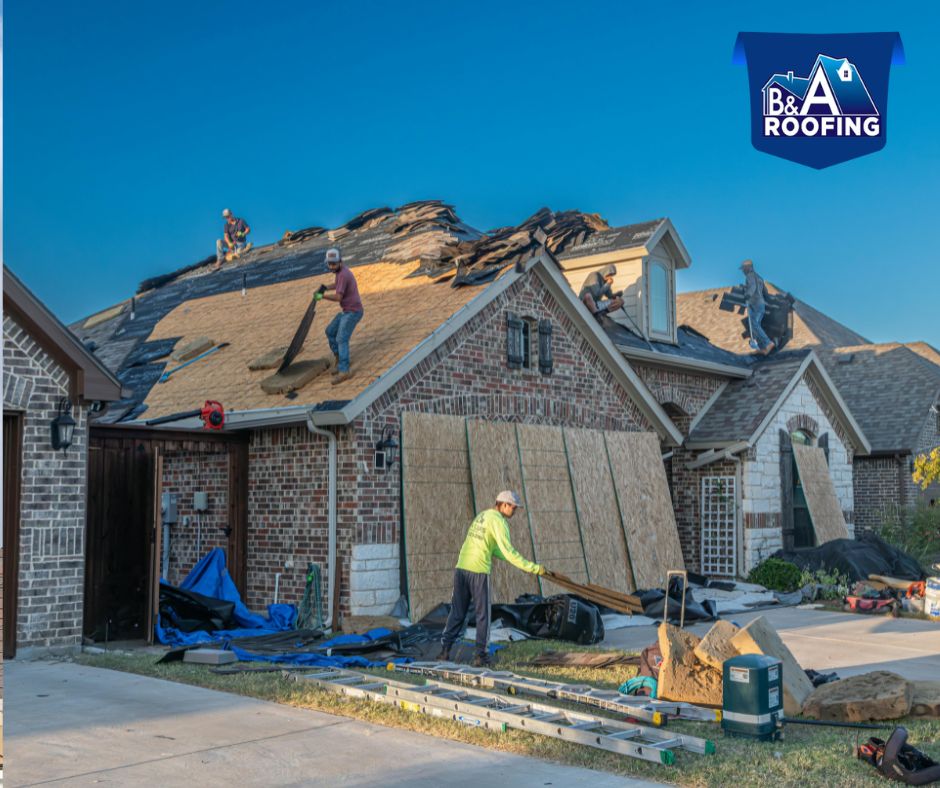
Emergency tarping is the first line of protection between your home and the next rain event when the roof has an open or compromised section. A properly installed tarp can protect a damaged roof for days to weeks while a permanent repair is scheduled and completed. A poorly installed tarp — or no tarp at all — can allow water infiltration that turns a $4,000 repair into a $15,000 project involving mold remediation and structural drying.
- Heavy-duty 6-mil poly or woven tarp covering at least 4′ past all damage on every side
- Extends over the ridge and is secured on both sides of the peak
- Fastened with wood battens screwed into the roof deck at the edges — not just draped
- Weighted at all four corners and edges to resist wind uplift
- Removes and disposes of any penetrating debris before install
- Documented photographically before and after placement
- Single-thickness lightweight tarp thrown over the damage area
- Not secured at the ridge — wind drives under and lifts it
- Held down with rocks, shingles, or debris instead of fastened edges
- Does not extend past the damage area on all sides
- Installed over the debris rather than after debris removal
- Creates water collection points instead of shedding rain
- Any damage on a roof above single-story with slope greater than 4:12
- If debris is still on the roof — removal requires assessment before tarping
- Active rain during the tarping period
- If the tarp needs to be insurance-documented for the claim
- Tree limbs still bearing weight on the deck
- When structural damage may be present underneath the affected area
❓ FAQ: How do I find a legitimate emergency roofer after a storm?
The most reliable approach is to call a contractor you already have a relationship with, or who was referred by a neighbor or insurer before the storm. In practice, after a major storm event most homeowners are calling contractors cold — which is where the risk is highest. The two most protective questions you can ask any contractor who contacts you or who you contact after a storm: “Do you have a permanent physical office in this state?” and “Can you provide your Alabama, Mississippi, or Georgia contractor license number right now?” A legitimate regional contractor can answer both immediately. A storm chaser will stall, generalize, or deflect.
Other signals of legitimacy: the contractor does not ask you to sign an assignment of benefits as a condition of inspection; they do not require a deposit before the insurance claim is settled; they provide a written scope with itemized pricing before any work begins; and they have verifiable reviews in your specific market, not just generic national ratings. Whether you are looking for roof replacement near me at Hattiesburg, Huntsville, Birmingham, or anywhere across the Southeast, the same vetting standard applies. According to FEMA’s guidance on avoiding contractor fraud after natural disasters, storm-chasing contractor fraud is among the most common disaster-related scams, and the key protection is verifying local licensure and physical presence before signing anything.
Legitimate Contractor vs. Storm Chaser: The Side-by-Side
- Permanent physical office in the state — verifiable address
- Active state contractor license — provides number immediately
- GAF Master Elite® or equivalent manufacturer certification
- Written scope before any work begins, no exceptions
- No AOB required — you retain control of the claim
- Attends adjuster inspection with you
- Reachable one year later for warranty calls
- References from local homeowners in your specific market
- No local office — home base is out of state
- Cannot produce a license number on the spot
- Pressure to sign an AOB before inspection begins
- Verbal estimates only — no written itemized scope
- Requests large cash deposit immediately after storm
- Suspiciously fast timeline with no documentation
- Gone from the market within 60–90 days of the storm
- Reviews are generic national ratings with no local specificity
When Emergency Tarping Becomes Full Roof Replacement
The critical decision after any significant storm event is whether temporary protection buys time for repair, or whether the damage scope warrants immediate planning for a full roof replacement. This decision affects your insurance settlement, your timeline, and the total cost of the project. Here is how to think through it clearly.
These factors interact — a mid-age roof with isolated damage repairs well. An aged roof with interior water infiltration almost always warrants replacement planning.
❓ FAQ: Will my insurance cover emergency roof repairs?
Standard homeowner’s policies cover sudden storm damage as a named or open peril, which includes wind, hail, lightning, falling trees, and tornado events. Emergency tarping and temporary protective measures are typically covered as part of the loss mitigation obligation — your policy generally requires you to take reasonable steps to prevent further damage, and reasonable emergency tarping costs are part of that. Keep all receipts and document the work photographically.
The distinction that matters for the long term is whether your policy is Replacement Cost Value (RCV) or Actual Cash Value (ACV). An RCV policy pays the full cost of replacement with like materials, minus your deductible — depreciation is withheld initially and released when the work is completed. An ACV policy pays the depreciated value of the damaged system, and that depreciation is not recoverable regardless of what you do. For an older roof, the ACV gap between the settlement and the actual replacement cost can be substantial. Knowing which you have before the storm and before your adjuster arrives is the single most useful piece of policy knowledge a homeowner can have. Whether you need roof replacement near me at Huntsville or anywhere across our markets, B&A Roofing attends adjuster inspections and handles supplement requests to maximize your settlement under whichever policy type you carry.
Specialty Roofing Systems After Storm Damage
Metal and flat roof systems require specific attention after storm events because the damage indicators and emergency repair approaches differ significantly from asphalt shingle work.
For metal roofing, the post-storm priorities are: assessing whether any panels have separated at seams or clips under wind load; checking exposed-fastener systems for backed-out or missing screws; and evaluating coating integrity at any dent sites where the paint film may have cracked and exposed bare metal to corrosion. Emergency repair on a metal system typically involves re-sealing lifted seams, replacing any punctured panels, and applying a temporary sealant to any coating breaches. For longer-term maintenance after a storm event, our guide on the best paint for metal roof coatings explains how to evaluate whether a recoat is needed and what coating standards hold up in Southeast conditions.
For flat and low-slope systems on commercial properties, storm response includes membrane puncture assessment, drain inspection and clearance to prevent post-storm ponding, and seam stress evaluation near any debris impact zones. A functioning flat roof drainage system is especially critical after major storm events when debris accumulation in drains can cause ponding that stresses an already-damaged membrane. Our commercial roof installation tupelo team handles emergency response on commercial flat and metal systems throughout North Mississippi with the same process standards as our residential work.
❓ FAQ: How quickly should a storm-damaged roof be permanently repaired?
The honest answer depends on the damage type, but the guiding principle is: as fast as the claim process allows without compromising the quality of the permanent work. For situations with active water entry — open decking, active interior leaks — emergency tarping should happen same-day and the permanent repair should be authorized as soon as the insurance scope is settled, typically within two to four weeks. Leaving an active entry point tarped through multiple additional storm events is a losing proposition: each event tests the tarp and adds incremental moisture to the building envelope.
For situations without active water entry — hail damage with no interior signs, minor wind damage that has been tarped — the timeline is governed by the insurance process, which typically runs 30 to 60 days from claim opening to settlement authorization. During that window, the priority is: get the contractor inspection done and documented, attend the adjuster appointment with your contractor, review the scope, and submit any supplement for missed items. Rushing to sign off on permanent work before the settlement is complete can leave money on the table. Waiting indefinitely after settlement is complete leaves you exposed. B&A Roofing provides a clear written timeline at every stage — so whether you need roof replacement near me at Birmingham or anywhere across Alabama, Mississippi, or Georgia, you always know exactly where the project stands and what comes next.
The Storm-to-Replacement Timeline: What to Expect
B&A Roofing’s Storm Response Across the Southeast
B&A Roofing operates seven permanent offices across Mississippi, Alabama, and Georgia — not a convoy following storm tracks, but locally rooted teams that were in your market before the storm and will be here for your warranty calls years after the repair. Every storm response follows the same process: free inspection, written damage report, contractor-attended adjuster appointment, complete supplement management, written scope before work begins, and post-completion documentation for your insurance file.
What Happens When You Call B&A After a Storm
- Same-day or next-day inspection for properties with confirmed active water entry or structural damage — emergency response is not a standard scheduled appointment.
- Emergency tarping when needed — properly installed, photographically documented, and included in the insurance claim scope as a covered protective measure.
- Written damage report within 48 hours — itemized, photographed, and formatted for insurance claim submission. Not a verbal summary.
- Contractor attendance at every adjuster inspection — we bring our scope, our measurements, and our documentation. Items the adjuster misses become the supplement.
- Full supplement management — we identify, document, and submit supplemental items until the claim scope accurately reflects the actual damage. You do not chase your own adjuster.
- Permanent repair or replacement completed to manufacturer specifications — the installation that unlocks the warranty tier you deserve, not a fast patch that looks fine on completion day.
Whether you need a trusted clarke county roofing company for a rural Mississippi property, a qualified roofing contractor athens al for a North Georgia storm claim, or the full-service storm response that b & a roofing delivers across every market we serve — the process is the same and the quality standard does not change with zip code.
Assignment of Benefits warning: If any contractor asks you to sign an AOB (assignment of benefits) as a condition of getting an inspection or starting work, stop. An AOB transfers control of your insurance claim from you to the contractor. Once signed, the contractor negotiates directly with your insurer, controls what work gets done and what gets claimed, and you lose the ability to dispute the scope or the settlement. Mississippi, Alabama, and Georgia all have statutes addressing AOB abuse. B&A Roofing never requires an AOB — you retain full control of your claim at every stage.
Your single most valuable pre-storm action: Right now, before any storm, pull out your homeowner’s policy and confirm three things: whether you have RCV or ACV coverage, what your deductible is for wind and hail claims (often separate from your standard deductible), and whether you have ordinance or law coverage that pays for code-upgrade requirements during a replacement. Five minutes of policy literacy today saves thousands in settlement surprises after a storm.
Storm Just Hit? We’re Already on It.
B&A Roofing responds to storm damage across Mississippi, Alabama, and Georgia with emergency inspections, professional tarping, and full insurance claim management — including roof replacement near me at Hattiesburg, Huntsville, and Birmingham. GAF Master Elite® certified. Seven permanent offices. No storm chasers, no AOB pressure, no surprises.
Request Emergency Inspection NowFree inspections · Emergency response · Insurance claim management included · MS · AL · GA