


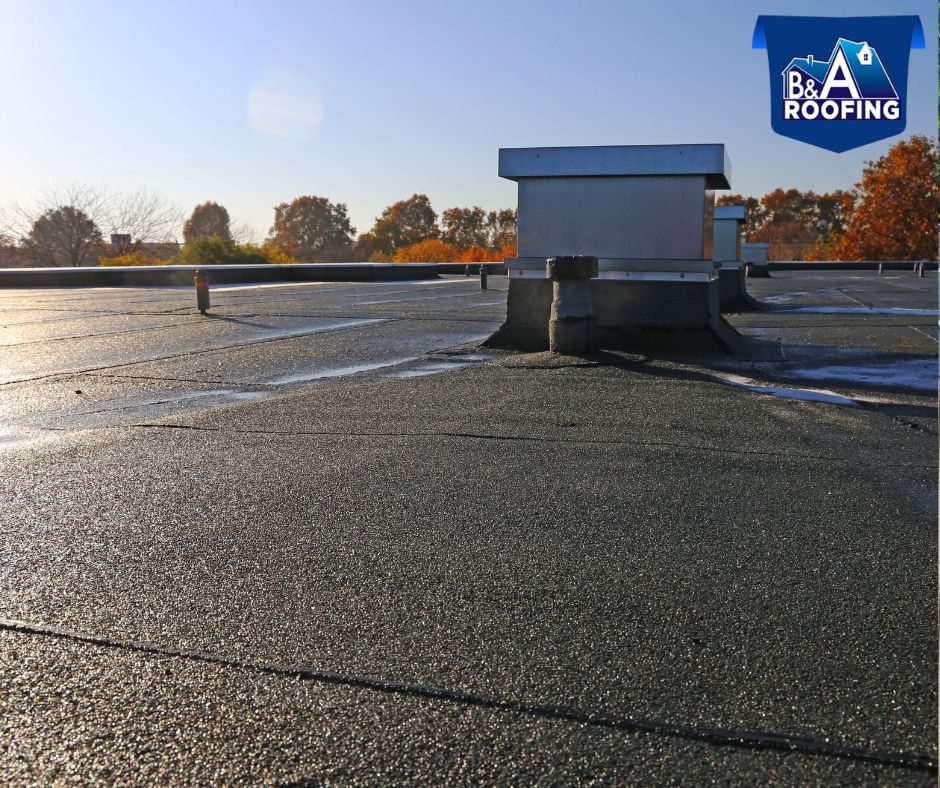
Flat Roof Drainage and Ponding Water in Southaven
❓ FAQ: Why does water pond on a flat roof?
Water ponds on a flat roof when the drainage system cannot remove standing water faster than it accumulates, or when the roof surface has developed low spots — either through original design, structural deflection over time, or localized deck compression — where water collects and has no path to a drain. Properly designed flat roofs are not actually flat: they are built with a minimum slope of one-eighth inch per foot to one-quarter inch per foot directed toward drain points, scuppers, or gutters. When a Southaven commercial property shows standing water 48 hours after a rain event, one of three conditions is present: the drainage system is undersized or blocked for the rainfall intensity the site receives, the roof structure has deflected and created low spots that defeat the original design slope, or the roof was installed without adequate slope from the beginning — a construction quality issue that is more common in fast-growing markets with high volume construction activity than in more mature, established markets.
DeSoto County’s rapid development pace is directly relevant here. Southaven’s commercial strip has seen substantial construction and commercial tenant buildout over a compressed timeframe, and the variance in construction quality across that volume is real. Drainage systems sized to national code minimums may be adequate for average rainfall but insufficient for the intense thunderstorm events that Mississippi’s summer seasons produce regularly — events where three to five inches of rainfall arrive in one to two hours and test drainage capacity in ways that steady rain events never reveal. Our detailed guide on how a properly designed flat roof drainage system is engineered for local storm intensity covers drain sizing, scupper design, and slope specification in the context of high-intensity Gulf South rainfall events that national code minimums underestimate.
What Causes Ponding: The Six Root Sources
🚰 Blocked or Clogged Drains
The most common and most correctable cause. Debris from roof-mounted HVAC equipment, windblown leaves and trash, and biological growth accumulation at drain openings reduce drain capacity. On Southaven’s commercial corridor where HVAC units are numerous and loading dock activity generates debris, drain blockage is a maintenance issue that recurs without a regular cleaning schedule.
🏗️ Structural Deck Deflection
Roof deck structures deflect slightly under their own weight and under the load of HVAC equipment, membrane systems, and ballast. Over 10 to 20 years, that deflection creates low spots in areas that were originally designed with adequate slope. Common in Southaven’s older commercial strip and in buildings where HVAC equipment has been added or relocated since original construction.
📐 Insufficient Original Slope
Some Southaven commercial properties were constructed with inadequate roof slope — below the minimum one-eighth inch per foot standard. This is a design or construction quality issue that manifests as chronic ponding in the same locations after every rain event. Correction requires either slope restoration through tapered insulation or drain additions, not simply cleaning what is already there.
🪜 Undersized Drainage for Mississippi Rainfall
Drain sizing based on national code minimums may handle a one-inch-per-hour design storm but fail to clear a three to four inch per hour DeSoto County summer thunderstorm event. Ponding that only appears during intense events but clears within hours is often a drainage capacity issue rather than a slope or blockage issue — and the solution is additional drain capacity, not just cleaning.
🚧 Parapet Wall Scupper Failure
Scuppers are the openings in parapet walls that allow surface water to drain off the roof perimeter. When scuppers are set too high, improperly sized, or blocked by debris, water backs up across the roof plane before finding an overflow path. Scupper height above the roof membrane surface should be set at one inch maximum to provide effective primary drainage.
🔧 Membrane Settlement at Repairs
Previous patch repairs that were not properly integrated with the surrounding membrane can create low-spot conditions at the repair perimeter. As membrane systems age and repairs accumulate, the original designed slope can be disrupted at multiple repair locations, each contributing a small additional depression that compound into chronic ponding areas.
❓ FAQ: Is ponding water harmful?
Yes — and the harm accumulates faster in Southaven’s climate than national guidelines often suggest. The standard industry definition of a problematic ponding condition is any standing water that remains on the roof surface 48 hours after a rain event has ended. By that definition, the water has exceeded the timeframe within which the membrane system’s design tolerates standing moisture, and active degradation is occurring. In DeSoto County’s combination of summer heat and high UV intensity, the degradation mechanism on a standing water zone is specific and measurable: the UV that reaches the wet membrane surface is transmitted through the water layer in a pattern that concentrates UV exposure on the membrane beneath, accelerating surface oxidation and reducing the elastomeric properties of the membrane faster than dry sun exposure would do on the same material.
The second harm mechanism is seam and flashing stress from hydrostatic pressure. A three-inch deep standing water column — not unusual after an intense DeSoto County thunderstorm on a roof with blocked drains — exerts approximately 0.18 pounds per square inch of pressure on any seam or flashing in the ponding zone. Over repeated ponding events, that pressure works adhesive-bonded EPDM seams and improperly welded TPO seams open in ways that gradually-draining water never would. The result is a flat roof leak Southaven property owners eventually discover at the interior ceiling — often months after the first ponding event that initiated the seam failure. Structural concern is also real: most commercial flat roofs in Southaven are engineered for a design live load that assumes standard drainage conditions. Chronic ponding that adds standing water load on top of the normal dead load and live load can stress structural members in buildings where the original design did not account for that added weight.
What Ponding Water Does to a DeSoto County Roof Over Time
A Southaven commercial property owner who addresses chronic ponding through tapered insulation, drain additions, or scupper corrections can recover 8 to 12 years of membrane service life relative to leaving the condition untreated. That recovery value, measured against the cost of a full membrane replacement, almost always justifies correction at the earliest possible point.
Flat Roof Systems in Southaven: What Is on Most DeSoto County Commercial Roofs
❓ FAQ: What materials are used on flat roofs?
Five membrane systems cover the majority of Southaven’s commercial flat roof inventory, and they differ significantly in how they respond to ponding water, how they are repaired, and what their realistic service life is in DeSoto County’s specific climate. TPO (thermoplastic polyolefin) is the most commonly installed system on new commercial construction in Southaven’s recent development boom. It is a white single-ply membrane with heat-welded seams that provides excellent UV and heat reflectance — meaningfully reducing roof surface temperature and interior cooling loads in Mississippi’s intense summer heat. EPDM (ethylene propylene diene terpolymer), commonly called rubber roofing, is the older single-ply standard and appears on a significant portion of Southaven’s commercial inventory that was built or reroofed 15 or more years ago. Its adhesive-bonded seams are its primary maintenance concern in hot climates.
Modified bitumen is a two-layer system using a polymer-modified asphalt base and cap sheet, and it is the most common system on residential additions, covered porches, and smaller commercial applications in DeSoto County. It is more repairable by a wider range of contractors than TPO, which requires heat-welding equipment and trained crews for proper seam repair. Built-up roofing (BUR), the traditional multi-layer gravel-topped system, is present on older Southaven commercial buildings and is increasingly replaced with TPO or modified bitumen at end of service life. Spray polyurethane foam (SPF) is used on irregular roof shapes and penetration-heavy sections where seamless application is an advantage. For TPO roof repair Southaven specifically, the repair methodology differs from EPDM and modified bitumen in ways that matter: TPO seams require heat welding for a durable repair, and a caulk or lap sealant applied over a TPO seam failure is a temporary patch, not a functional restoration of the welded joint. According to EPA guidance on cool roofs and heat island reduction, white reflective membranes like TPO reduce roof surface temperatures by 50 to 60°F compared to conventional dark roofing — a particularly meaningful energy and longevity benefit in Southaven’s sustained summer heat.
- White reflective surface reduces cooling loads 15 to 25%
- Heat welded seams — strongest seam type available
- Dominant system on new Southaven commercial builds
- Seam repair requires heat welding equipment and trained crew
- Adhesive bonded seams — main maintenance point
- Excellent UV resistance despite dark color
- Common on pre-2010 commercial inventory in Southaven
- Seam adhesive softens in sustained Mississippi summer heat
- Two-layer system — base and cap sheet
- Most common on residential additions and small commercial
- Easiest to repair — accessible to more contractors
- Granule cap provides UV protection and some impact resistance
- Multiple bitumen and felt layers — no field seams
- Gravel aggregate surface for UV protection and ballast
- Common on older Southaven commercial properties
- Increasingly replaced with TPO at end of service life
- Heat welded seams like TPO — excellent waterproofing
- Superior grease and chemical resistance
- Best for restaurant rooftops and kitchen exhausts
- More dimensionally stable than TPO at temperature extremes
- Seamless — no seam failures possible
- Excellent for irregular shapes and penetration-heavy sections
- Adds meaningful insulation R-value to the roof assembly
- Requires periodic elastomeric topcoat renewal
Drainage System Comparison: What Southaven Commercial Roofs Need
| Drainage Component | Standard Code Minimum | DeSoto County Recommendation | Why the Difference Matters |
|---|---|---|---|
| Primary drain size | Based on 1 to 2 in/hr design storm | Size for 4 in/hr storm intensity | DeSoto County summer events regularly exceed code design assumptions |
| Drain spacing | One drain per 10,000 sq ft (varies by code) | One drain per 4,000 to 6,000 sq ft | Reduces ponding time during intense events and removes isolated low spots |
| Secondary overflow | Required; size varies | Size equal to primary system | Overflow drains are the life safety backup — undersizing them is the highest risk failure |
| Scupper height above membrane | Up to 2 in above membrane | Maximum 1 in above membrane | Lower scupper height reduces maximum ponding depth before overflow activates |
| Drain cleaning frequency | Annually in most guides | Biannually minimum in Southaven | Heavy debris load from commercial activity and summer biological growth fills drains faster |
| Slope from drain to roof perimeter | 1/8 in per foot minimum | 1/4 in per foot preferred | Greater slope increases drain rate and reduces low-spot formation over time |
Correcting Ponding: The Right Fix for Each Root Cause
Clean and Clear All Drains and Scuppers
Before any structural or drainage modification is designed, confirm that every drain opening is fully clear of debris, that clamping rings are secure, and that scupper openings are unobstructed. Significant ponding issues are sometimes fully resolved by a thorough drain cleaning. This is always the first step because it eliminates the simplest root cause at the lowest cost before committing to more significant interventions.
Map the Ponding Zones with Topographic Survey
After clearing drains, observe the roof surface during or immediately after a rain event to document where water accumulates, how deep it gets, and how long it takes to clear. This observation data is the design input for any slope restoration or drain addition project. Without mapping the actual low spots, any correction is a guess at best.
Add Drains at Ponding Zone Centers
For ponding zones where the low spot location is clearly identified and a new drain can be penetrated through the deck to an interior drainage path, adding a drain at the center of the ponding area is the most direct correction. This requires coordination with the building’s interior drainage routing and may require a structural opening through the deck if no drain access point currently exists.
Install Tapered Insulation for Slope Restoration
Where the ponding is caused by insufficient original slope across a broad area rather than a discrete low spot, tapered insulation boards installed over the existing membrane create a new slope directing water toward the drain system. This is the most comprehensive correction for chronic design-related ponding and is commonly combined with a full membrane reroof on older Southaven commercial properties where the existing membrane is approaching end of service life anyway.
Inspect and Repair All Membrane Seams in Ponding Zones
After drainage is corrected, assess every seam and flashing in the previously ponding zone for signs of stress, separation, or edge lift that the chronic water load may have initiated. On TPO systems, re-weld any seam showing edge lift or inadequate bond. On EPDM, re-bond any seam showing adhesive separation. Addressing the membrane integrity simultaneously with the drainage correction prevents a situation where the corrected drainage reveals a flat roof leak Southaven that the standing water had been masking.
B&A Roofing Flat Roof Services for Southaven and DeSoto County
- Free commercial flat roof inspection with written condition report — membrane condition assessment, seam status, flashing inspection, drainage performance, and a written repair versus reroof recommendation with both cost options documented.
- Drain cleaning and maintenance programs — biannual drain cleaning with inspection and minor repair for commercial property managers who want documented maintenance records and early intervention on developing conditions before they become emergency repairs.
- TPO seam repair and re-welding — certified equipment and trained crews for proper TPO weld repair. We do not apply lap sealant over TPO seam failures and call it a repair.
- Ponding zone assessment and drainage correction design — topographic observation, drain addition planning, tapered insulation specification, and scupper adjustment coordination as appropriate to the specific property’s root cause.
- Full membrane reroof — TPO, EPDM, and modified bitumen reroof over properly prepared substrate with all penetrations and flashings addressed in the base scope. No deferred items.
B&A Roofing’s Tupelo office serves the full DeSoto County and North Mississippi market including Southaven. Our commercial roof installation tupelo team handles both emergency flat roof repair Southaven calls and scheduled maintenance programs across the DeSoto County commercial corridor. Our comprehensive roofing services across North Mississippi include both flat membrane systems and sloped roofing for the full range of residential and commercial property types in the area. For complete cost context on flat roof repair and replacement projects in our Mississippi markets, our guide on new roof costs covers membrane replacement alongside asphalt and metal options. For North Alabama commercial projects, our huntsville roof team and our fascia installation cullman al team apply identical flat roof inspection standards. Our roofing contractor in birmingham office handles Birmingham-area commercial flat roof work. When comparing membrane systems for a sloped commercial section alongside a metal alternative, our guide on the best paint for metal roof coatings covers the interface between metal panel systems and adjacent flat sections on mixed-slope commercial roofs. For residential sections where shingle specification affects the decision, our guide on roof shingles brands provides the relevant product comparison context.
The Southaven construction pace warning: DeSoto County’s rapid commercial development has attracted contractors from across the Mid-South who have installed flat roof systems in the area without specialist flat-roof crew experience. The most common quality gap is TPO seam installation: a seam that appeared welded at installation but was welded at too low a temperature or too short a duration will show edge lift within 2 to 5 years, typically following the first summer of sustained heat cycling. Before accepting a flat roof installation from any contractor, ask specifically about the crew’s TPO heat-welding certification and request reference contacts from comparable Southaven or DeSoto County commercial projects they have completed.
The most cost-effective flat roof drainage Southaven maintenance step available at zero cost: Walk your roof after every significant rain event and observe where water is standing and how long it takes to clear. Documenting this observation with photographs twice per year creates the baseline data that makes a drainage correction project far easier to scope accurately — and helps you catch a developing ponding problem before it has degraded a significant membrane area. A ten-minute monthly observation pays for itself many times over in early intervention value.
Flat Roof Ponding in Southaven? Get the Right Assessment.
B&A Roofing provides free flat roof inspections with written condition reports and honest drainage correction versus reroof guidance across Southaven and DeSoto County. GAF certified. Written findings. No pressure. Call or click to schedule.
Get Your Free Southaven Flat Roof AssessmentFree inspections · Drainage assessment · TPO and EPDM repair specialists · DeSoto County and North MS · (662) 636-7663