


How to Find the Source of a Roof Leak in Huntsville
Where the Water Shows Up Is Rarely Where It Gets In
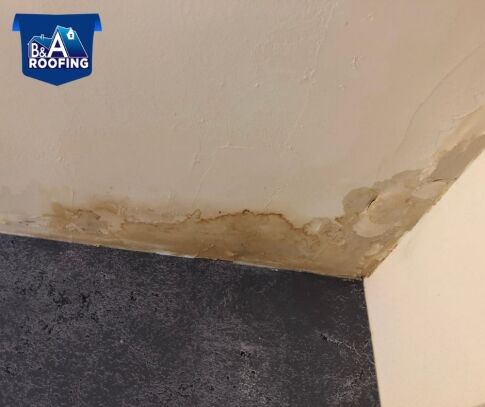
Think of your roof as a series of layers designed to shed water downhill. When water gets past the top layer, it does not drop straight down. It follows the path of least resistance along the underlayment, the decking, and the framing until gravity gives it somewhere to fall, whether that is a ceiling seam, a light fixture, or an exterior wall. That is why a stain in the living room can trace back to a flashing detail on the other side of the roof ridge.
The longer the path along decking and framing, the farther the stain can sit from the true entry point, which is why guessing from the ceiling alone so often misses.
❓ FAQ: Why is finding a leak hard?
Five things make it genuinely difficult, even for experienced people. First, water travels, as we just saw, so the stain is a clue rather than an address. Second, leaks are often intermittent. Many only appear when wind driven rain hits one side of the house, or only after a long soaking rain, so a roof can look fine for weeks. Third, insulation and decking hide the evidence. By the time a stain reaches the ceiling, water may have been moving through the attic for a while. Fourth, there is often more than one cause. A cracked vent collar and a failing flashing can overlap, and fixing one does not stop the drip from the other. Fifth, not every wet spot is a roof leak. Condensation in an attic, a leaking air conditioning drain line, or plumbing can all mimic one.
For a growing market like Huntsville, one more factor applies: rooflines on newer homes often include many pitch changes, dormers, and penetrations, which gives water more places to enter and more paths to follow. Our full range of roofing services starts with finding the true cause before anyone suggests a repair, and that is why a proper roof leak inspection Huntsville homeowners can trust always includes the attic, not just a walk across the shingles.
Why Huntsville Homes Have Their Own Leak Patterns
Huntsville has grown quickly, and entire neighborhoods across Madison County were built in a short window. That means thousands of roofs are now the same age, built with similar details, and facing the same hail, wind, and occasional winter ice that North Alabama delivers. Patterns repeat. A weak detail on one house is often a weak detail on the whole street. A good roof leak detection Huntsville approach takes those patterns into account.
🏗️ Builder Flashing and Sealant Details
On fast built homes, step flashing, kick out flashing, and caulked penetrations are frequent leak points. Sealant ages in sun and heat, and a detail that held for five years can open up by year ten.
🧱 Many Penetrations, Many Chances
Plumbing vents, bath fans, HVAC flues, and roof vents each add a spot where water can enter. Rubber vent collars crack with sun exposure and are one of the most common culprits on homes under 15 years old.
⛈️ Hail Bruising That Leaks Later
Hail can fracture the mat under the granules without causing an immediate leak. Water may not show up inside until weeks or months later after repeated rain.
🌬️ Wind Lifted Shingles and Edges
Strong thunderstorm winds can lift tabs and break seals. A lifted shingle may leak only when rain blows from the same direction as the wind that lifted it.
❄️ Winter Ice and Freeze Thaw
Freezing rain and repeated freeze and thaw cycles widen small gaps at flashings and sealant lines. A leak that first appears days after an ice event often traces to this.
💧 Attic Condensation
Warm moist air meeting a cold roof deck in winter can leave frost and drips that look like a leak. Poor ventilation or air leaks from the living space below are usually the cause.
Start in the Attic: Your Best Clue Source
The single most useful step in tracing a leak is going to the attic, ideally while it is raining or right after. This is where you can see the underside of the roof deck and follow the water back toward its source. If you ever catch a leak in attic after rain, resist the urge to only look at the ceiling below. The evidence in the attic is fresher and more specific.
❓ FAQ: Can I check the attic myself?
Yes, if you can do it safely, and it is one of the most helpful things a homeowner can do before calling anyone. Bring a bright flashlight, wear long sleeves, gloves, a dust mask, and sturdy shoes, and step only on the wooden joists or on boards laid across them. Never step on the drywall between joists or you can fall through the ceiling. Look for dark stains or dampness on the underside of the roof deck, wet or matted insulation, water trails running down rafters, rusted or frosty nail tips poking through the deck, and any spot where you can see daylight. Take photos of anything you find and note roughly where it is relative to features you can identify from outside, such as a vent pipe or chimney.
A few safety notes matter. Attics can be extremely hot, so go in the cooler part of the day. Avoid touching wet insulation near wiring, and stay away from any area where wiring looks damaged or wet. If you see widespread dark growth, a strong musty smell, or standing water, stop and call a professional. The U.S. Environmental Protection Agency’s guide to mold, moisture and your home stresses that moisture control is the key to mold control and that water damaged areas should be dried within 24 to 48 hours to help prevent mold growth, which is one more reason not to wait on an active leak.
Note the Conditions
Write down when the leak appears: during rain, after rain, only with wind, or only after freezing weather. Timing is a powerful clue.
Mark the Stain Location
Measure from two walls to the center of the ceiling stain so you can find the same spot in the attic.
Go Up and Look Uphill
In the attic, find the matching area, then look up the slope toward the ridge. Water enters higher than it shows. Follow wet trails uphill to where they begin.
Check Every Penetration Nearby
Look at the underside of the deck around plumbing vent pipes, flues, fans, and skylights. Staining that radiates around a pipe points straight at the collar or flashing.
Photograph and Stop
Take dated photos and stay off the roof. A wet roof is dangerous, and walking it can damage shingles. Share your findings with a professional.
Read the Clues: What Your Interior Evidence Is Telling You
| What You See | Likely Source to Check First | Why |
|---|---|---|
| Ring stain that grows after each rain | Penetration or flashing above | Repeated wetting from a point source builds concentric rings |
| Stain near an exterior wall or ceiling edge | Step flashing, siding transition, or eave | Water runs down the wall plane or enters at the roof to wall junction |
| Stain below a chimney, skylight, or dormer | Flashing or cricket at that feature | Large features need multiple flashing pieces, each a potential gap |
| Drips from a ceiling light or fan | Water traveling along framing to the fixture | Fixtures are low points where water exits. Treat as an urgent electrical risk |
| Stains only after wind driven rain from one direction | Lifted shingles, vent caps, or siding junctions on that side | Wind pushes water uphill under laps that shed normally in still rain |
| Frost or damp decking only in cold weather | Attic condensation, not a roof leak | Warm moist air from the home condenses on a cold roof deck |
| Leak appears days after freezing rain | Freeze thaw widened gap at flashing or eave | Ice melt and refreeze works water into small openings over time |
Outside Clues You Can Spot from the Ground
With a pair of binoculars and dry weather, you can scan from the yard and safely collect clues without going near the roof. Look for shingles that are missing, curled, or visibly lifted, and for exposed or rusted nail heads. Check vent pipe collars for visible cracking. Look at the flashing around chimneys and where roof planes meet walls for gaps or sealant pulling away. Look at gutters for heavy shingle granules, which signal aging, and check the roof edge and fascia for staining. Note any area where moss or algae is thick, because it can hold moisture against the shingles. If the roof is metal, scan for loose or backed out fasteners and check the finish. Our guide on the best paint for metal roof systems explains why coating condition matters for metal roof leaks.
Order varies by roof. This is a practical checklist, not a prediction for your home.
What the Professionals Do Differently
❓ FAQ: Do professionals use special tools?
They do, and the tools are there to replace guessing with evidence. Depending on the roof and the situation, a professional’s toolkit can include moisture meters that detect hidden dampness in decking and drywall, thermal imaging cameras that reveal temperature differences caused by moisture, controlled water testing that applies water to one section of the roof at a time while a second person watches inside, borescopes and flashlights for tight spaces, drones or high resolution cameras for safe documentation, and for flat and membrane roofs, electronic leak detection or flood testing. The experience matters as much as the gear, because tools need interpretation. A thermal image can show a damp area, but a trained eye has to connect it to the real entry point.
B&A Roofing inspections begin in the attic and combine a close visual inspection of the roof surface with photographs of every finding, and we will tell you plainly if your roof needs a more specialized test to pin down a stubborn leak. If you are comparing providers, ask any contractor how they will confirm the source before they quote a repair. A real water intrusion roof Huntsville diagnosis should end with a clear explanation and photos, not a guess.
| Tool or Method | What It Does | Best Used For |
|---|---|---|
| Moisture meter | Measures moisture in wood and drywall | Mapping how far water has spread and confirming a spot is still wet |
| Thermal imaging camera | Shows temperature patterns that can indicate trapped moisture | Narrowing a search area, especially on low slope roofs |
| Controlled water test | Applies water in sections, lowest to highest, with an observer inside | Confirming which detail actually leaks when the cause is unclear |
| Attic inspection with photos | Traces stains, trails, and rusted fasteners uphill to the source | The first step for nearly every shingle roof leak |
| Drone or high resolution camera | Documents the roof safely from above and from distance | Steep, high, or hard to access roofs and insurance documentation |
| Electronic leak detection or flood test | Locates breaches in membrane roofing | Flat and low slope commercial and residential roofs |
For flat and low slope sections, finding the source also means checking how water leaves the roof, since ponding and blocked drains cause repeat leaks. Our guide on a properly designed flat roof drainage system explains why. And if tracing the leak shows the roof is near the end of its life, our guide on new roof costs gives regional benchmarks, and our guide on roof shingles brands compares the product lines. If you do end up choosing a new roof, our guide to popular roof colors can help with the fun part of the decision.
What to Do Right Now While You Track Down the Source
- Protect the home. Place a bucket under active drips and move belongings out of the way. If a ceiling is bulging with trapped water, keep people and electronics clear of that area and call a professional rather than trying to open it yourself.
- Mind the electrical risk. If water is coming through a light fixture or near wiring, turn off the power to that circuit and avoid the area.
- Document everything. Take dated photos of stains and attic findings, and note the weather conditions. This helps with both diagnosis and any insurance claim.
- Call early. A small leak is cheaper to fix and less likely to damage insulation and framing. If hail or wind caused the damage, early documentation matters for insurance.
We serve homeowners across the Tennessee Valley and beyond. You can browse our Alabama service areas to see local coverage, including our huntsville roof team in Madison County, our fascia installation cullman al and Cullman County team, our roofing contractor in birmingham office, and our commercial roof installation tupelo team for commercial properties in North Mississippi.
The best time to track a leak is during or right after the rain. Evidence is freshest, trails are still wet, and the path is visible. If you can safely get into the attic while it is raining, you will learn more in ten minutes than in an hour of dry weather guessing. Take video if you can. When you call B&A Roofing at (256) 886-7940, that footage helps us start narrowing down the cause before we arrive.
Stop Guessing. Find the Real Source.
B&A Roofing offers free leak inspections across Huntsville and Madison County. We start in the attic, trace the water back to its entry point, photograph what we find, and explain it in plain language with a written estimate. GAF Master Elite® certified.
Schedule Your Free Leak InspectionFree inspections · Photos and written findings · Huntsville and Madison County · (256) 886-7940