
DIY Roofing: When to Hire a Professional
The Honest Spectrum: DIY to Always-Hire-a-Pro
❓ FAQ: What roofing tasks can a homeowner safely do themselves?
There is a meaningful category of roofing-adjacent tasks that a capable homeowner can handle without professional involvement, and doing them yourself can save real money. Gutter cleaning and minor gutter reattachment on a single-story home is the clearest example — this requires a stable ladder, appropriate footwear, and basic tools, but no specialized roofing skill. Inspecting your own roof from the ground with binoculars after a storm is something every homeowner should do, and documenting what you see for a contractor or insurance claim is genuinely useful DIY work. Replacing one or two individual cracked shingles on a low-slope (4:12 or less), single-story roof is within reach for a careful homeowner who purchases matching materials and follows the manufacturer’s installation guide — though it requires safe ladder use, proper footwear, and working on a cool, dry day.
Beyond those tasks, the risk-benefit calculation shifts. Applying roofing cement or sealant to a visible gap is something homeowners attempt frequently, with mixed results — it can work as a temporary measure when the entry point is clearly defined, but it rarely produces a durable seal because the underlying cause (failed flashing, cracked boot collar, lifted shingle) is not addressed by surface sealant alone. According to U.S. Consumer Product Safety Commission guidance on ladder safety, falls from ladders cause an estimated 164,000 emergency room visits and 300 deaths per year — which is why even “simple” roofing tasks require honest self-assessment of comfort level at height before proceeding.
❓ FAQ: What are the risks of DIY roof replacement?
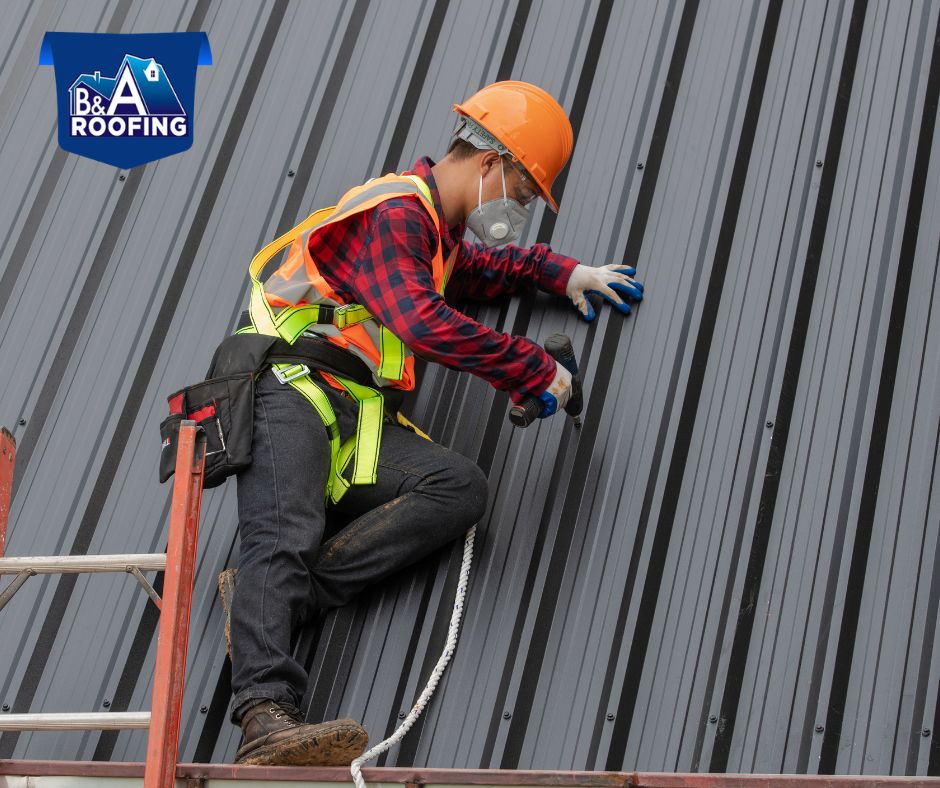
The risks fall into four categories, and all four are serious enough that a DIY full roof replacement almost never makes financial sense even for the most capable homeowner. The first is safety: a full roof replacement requires sustained work at height, carrying heavy material bundles (each shingle bundle weighs 50 to 80 pounds), working on a pitched surface in varying weather, and operating power fasteners at awkward angles. Falls from roofs are a leading cause of construction fatalities even among experienced professionals with fall protection equipment. A homeowner without that equipment and experience is at significantly higher risk.
The second risk is permit and code compliance. Most jurisdictions in Alabama, Mississippi, and Georgia require a permit for a full roof replacement, and that permit requires a licensed contractor in most cases. A roof replacement done without a permit can create title issues when you sell, insurance claim complications when you need coverage, and potential mandatory tear-off and redo at your expense if the non-permitted work is discovered during a real estate transaction or insurance inspection. The third risk is warranty voiding: manufacturer warranties on premium shingle systems require installation by a certified contractor. A DIY installation — even a technically correct one — produces no manufacturer warranty. And the fourth risk is the invisible quality problem: the most consequential aspects of a proper roof installation (nail pattern, underlayment overlap, ice-and-water shield coverage, drip edge sequencing) are hidden once the surface shingles go down. You will not know if you did it wrong until it leaks in year three. For realistic cost context on professional roof replacement near me at Huntsville or anywhere across our markets, our guide on roof repair cost tupelo mississippi and Southeast pricing benchmarks helps you evaluate the true cost comparison between DIY and professional work.
The Real Cost Comparison: DIY vs. Professional Replacement
The perceived savings of DIY roof replacement are often significantly larger than the actual savings, once you account for the full scope of what professional installation includes.
When equipment rental, warranty value, and repair risk are included, the true net savings of DIY replacement often fall below $1,000 on a project where the perceived saving appeared to be $4,000–$8,000.
What Happens to Your Insurance When You DIY
❓ FAQ: Does DIY roofing work affect my homeowner’s insurance?
Yes — and in several ways that most homeowners do not anticipate until they file a claim. First, a DIY roof replacement done without a permit (which is required in most jurisdictions and requires a licensed contractor) creates a documentation gap that an insurance adjuster can use to complicate or reduce a future claim. If your roof sustains storm damage five years after a DIY replacement and the adjuster asks for proof of proper installation, you have no contractor certification, no permit, and no warranty documentation to provide. The adjuster has grounds to attribute some of the damage to improper installation rather than the storm event.
Second, some insurance policies contain clauses that require work to be performed by licensed contractors. A DIY installation that is later discovered during an inspection or claim process can create a coverage dispute even for damage that has nothing to do with the installation quality. Third, a DIY replacement that produces a subsequent leak — which is statistically more likely than a certified professional installation — creates a secondary damage claim for interior water damage that the carrier may attribute to maintenance failure rather than a covered loss. The insurance implications of DIY roofing are not hypothetical risks — they are documented claim complications that adjusters are trained to identify. This is especially important for homeowners considering roof replacement near me at Birmingham or any Alabama market, where the state requires contractor licensing for projects above specific dollar thresholds.
The Smart Homeowner Play: Pre-Crew Prep Work
❓ FAQ: Can I save money by doing prep work before a roofer arrives?
Yes — and this is where a capable homeowner can contribute meaningfully without taking on the risk of the actual installation. Several preparatory steps that contractors typically include in their bid can be done by the homeowner in advance, either to reduce the bid cost or simply to accelerate the project timeline. The key is to discuss this with your contractor before the estimate so they can reflect your contribution in the pricing rather than billing for tasks you have already completed.
The most impactful homeowner prep tasks are: clearing the attic of any stored items near the areas where nails will be driven through (falling debris during tear-off is a real issue); clearing a 10-foot perimeter around the home of vehicles, patio furniture, and potted plants that would need to be protected during installation; relocating any outdoor decorations, satellite dish cables, or anything attached to the fascia or soffit that the crew would need to work around; and disconnecting and capping any older satellite dish mounts that are no longer active, so the contractor can properly flash those penetrations without a reinstall. Interior prep — removing pictures from walls, clearing the top floor of anything breakable — is also genuinely appreciated and reduces the chance of vibration damage to fragile items during tear-off.
- Clear 10-foot perimeter of vehicles, furniture, pots
- Move cars out of driveway and away from the home
- Clear attic of stored items near the roof plane
- Remove pictures and wall decorations from interior walls (vibration during tear-off)
- Identify and note all active penetrations (satellite dishes, solar conduits, vents)
- Cap and remove any inactive satellite dish mounts
- Ensure crew has access to a water source and restroom
- Communicate pet and child schedule so crew can work without interruption
- Mark any soft landscaping you want protected from debris
- Take photos of the roof, attic, and all gutters before crew arrives (for your records)
- Removing existing shingles or roofing material
- Inspecting or probing the decking for soft spots
- Applying ice-and-water shield or underlayment
- Installing or adjusting any flashing
- Modifying gutter attachments at the fascia
- Removing or repositioning any pipe boots or vent caps
- Anything that requires going on the roof surface
- Any work with a nail gun or compressed air tools
- Adjusting or disconnecting any active satellite equipment
- Debris hauling or dumpster placement decisions
Common DIY Attempts and Why They Fail
| DIY Attempt | Why It Seems Reasonable | Why It Typically Fails | Actual Cost When Wrong |
|---|---|---|---|
| Caulk over a flashing gap | Leak is visible; caulk is easy to apply; stops dripping immediately | Caulk over metal flashing does not bond durably; thermal cycling breaks the seal within 1 season; root cause (failed flashing) is not addressed | $600–$1,800 flashing replacement + any secondary damage |
| Lay new shingles over old (overlay) | Avoids tear-off labor; cheaper upfront; shingles cover the problem | Added weight stresses decking; traps moisture; voids manufacturer warranty; most codes prohibit more than 2 layers; underlying problems persist beneath new surface | Double tear-off cost + full replacement when overlay fails |
| Apply roofing cement to pipe boot | Visible crack; inexpensive fix; stops active drip | UV degrades cement within 1–2 seasons; boot continues to shrink away from pipe; interior damage accumulates while surface looks sealed | $200–$500 boot replacement + water-damaged insulation remediation |
| Nail down lifted shingles with roofing nails | Shingle is visibly lifted; driving a nail seems like the fix | Nails driven through shingle face without proper sealant create new penetrations; adhesive bond issue is not resolved; shingle lifts again next wind event | $300–$800 for proper shingle section replacement |
| DIY full replacement on 2-story home | Material cost seems manageable; watched tutorial videos | Fall risk at 2-story height without proper equipment; permit violations; no manufacturer warranty; quality issues invisible until leaks appear | Full professional replacement + potential redo of flawed sections — $15,000–$25,000+ |
❓ FAQ: When is hiring a professional roofer always the right choice?
Six scenarios where there is no meaningful argument for DIY and the only question is which professional to hire. First: any full roof replacement, regardless of home size, pitch, or your skill level. The fall risk, permit requirements, warranty implications, and invisible quality dimension make professional installation the only rational choice. Second: any work on a roof above single-story height or with a pitch steeper than 6:12. The fall risk at these levels requires professional fall protection equipment and experience — not determination. Third: flashing repair or replacement of any kind. Step flashing, counter-flashing, chimney flashing, valley metal — each requires proper integration with the underlayment sequence that is extremely difficult to replicate correctly without repeated hands-on training.
Fourth: any skylight repair, reflash, or installation. The flashing detail around a skylight curb is one of the most exacting in residential roofing. Incorrect installation here produces the most persistent and difficult-to-diagnose leaks on any roof. Fifth: any work related to an active insurance claim. A DIY repair on storm damage before the adjuster inspection can compromise your claim — work that changes the visible condition of the damage before it is documented reduces your ability to recover the full cost of professional repair. Sixth: commercial roofing of any kind. TPO, EPDM, and modified bitumen systems require welding equipment, specialized application techniques, and material-specific training that go well beyond residential skills. For any of these scenarios, the conversation is about which contractor, not whether to hire one. Whether you need roof replacement near me at Hattiesburg, a commercial membrane system from our commercial roof installation tupelo team, or a rural Mississippi project from a trusted clarke county roofing company, the right professional exists for your specific situation. A qualified roofing contractor athens al applies the same always-hire standard for the work that genuinely requires it. b & a roofing is that professional across all seven of our Southeast markets.
Specialty Systems: Metal and Flat Roofs Are Never DIY Territory
If asphalt shingle DIY replacement is inadvisable for most homeowners, metal and flat roof systems are categorically off the table. Standing seam metal panels require specialized bending equipment, clip installation at precise tolerances, and seaming techniques that prevent oil canning and panel movement. An incorrectly installed standing seam panel that looks fine at completion will develop fatigue cracks at the seam within a few seasons under thermal cycling. Our guide on the best paint for metal roof systems is a useful resource for metal roof owners — even maintenance work like recoating requires proper surface preparation that most homeowners underestimate.
Flat membrane systems require heat welding or adhesive bonding of seams that determine whether the waterproof plane is intact. A seam that appears fused but is not bonded to the required peel-strength spec will fail at the next ponding event. Our overview of how a functioning flat roof drainage system works explains why flat roof maintenance requires professional assessment — even routine tasks like drain clearing need to happen in the context of understanding the entire drainage plane.
Failure rate = required professional correction within 3 years, including partial redo, recurring leaks, or secondary damage from original DIY attempt. Southeast climate accelerates sealant and rubber degradation, increasing failure rates vs. drier regions.
The Honest Bottom Line on DIY vs. Professional
- Do the ground-level inspection, the attic check, the gutter cleaning, the perimeter prep before a contractor arrives, and the photo documentation. These are meaningful contributions that save money and improve outcomes.
- Consider carefully a single shingle replacement on a low-pitch single-story roof if you are genuinely comfortable at height, have the right materials, and understand the correct technique. Know your limits.
- Do not attempt flashing repair, any multi-shingle section work, skylight repair, or anything on a two-story or steep-pitch roof. The risk-benefit math does not work.
- Never attempt a full roof replacement near me at Birmingham or anywhere else as a DIY project. The hidden quality dimension, the permit and insurance implications, the fall risk, and the warranty voiding collectively make it a losing proposition regardless of skill level.
- A professional inspection costs nothing with B&A Roofing. If you are uncertain whether you have a DIY task or a professional repair, the free inspection gives you the information to decide without committing to anything.
The smartest thing a handy homeowner can do: Invest your DIY energy in annual maintenance — gutter cleaning, perimeter inspection, attic moisture checks, and trimming overhanging branches. These free tasks extend the life of any professional installation and give you early warning of developing problems. Then call a certified contractor for the things that genuinely require professional skill. The combination of engaged homeowner attention and certified professional execution produces the best long-term outcomes.
Not Sure if You Need a Pro? Let’s Find Out Together — for Free.
B&A Roofing provides free inspections with honest findings across Mississippi, Alabama, and Georgia — including roof replacement near me at Huntsville, Birmingham, and Hattiesburg. We will tell you exactly what the condition is, what can be maintained, and what requires professional repair or replacement. No pressure. Written scope before any work.
Schedule Your Free InspectionFree inspections · Honest repair vs. replace guidance · GAF Master Elite® certified · MS · AL · GA